 Oahu Boat Tours
Turtle Canyon Oahu Snorkeling: What It Is and What You'll See
Last reviewed August 2026
Turtle Canyon, Oahu's most dependable snorkel reef, is a natural cleaning station about 15 boat minutes off Kewalo Basin, near Diamond Head, where reef fish groom green sea turtles that gather there to feed and rest. It isn't a canyon in any geological sense and it isn't reachable from shore. Two catamarans snorkel it daily, and on a good day divers report seven to ten turtles along with rays, octopus and the occasional pod of spinner dolphins passing through on the ride out. This guide covers what the site actually is, what you'll realistically see, how it stacks up against Hanauma Bay, and the rules that keep the turtles wild.
Quick answer
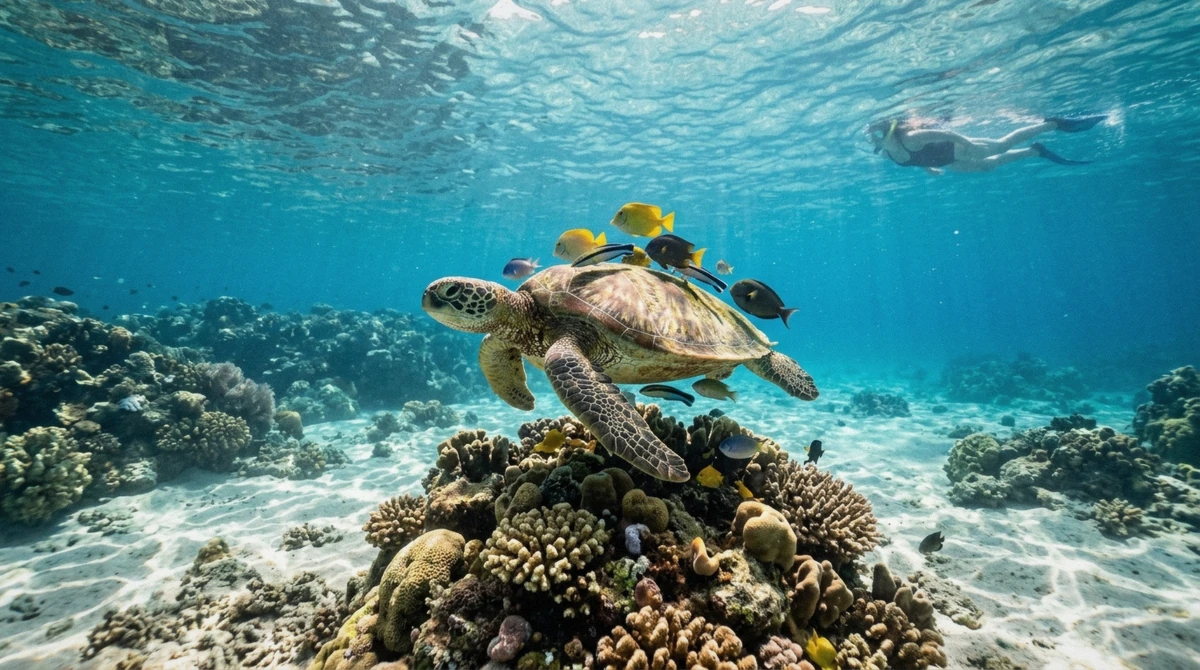
Turtle Canyon is a cleaning-station reef about 15 boat minutes off Kewalo Basin, near Diamond Head, where green sea turtles gather to have reef fish pick algae off their shells. You'll almost always see turtles there, often several rays and octopus too, and on a good day a pod of spinner dolphins on the way out. It's boat-only: there's no shore access and no way to swim there on your own.
Key takeaways
- Turtle Canyon is a cleaning station, not a canyon: reef fish groom green sea turtles that gather there, about 15 minutes by boat from Kewalo Basin
- Two catamarans run it daily. The $59.99 turtle snorkel carries a full-refund guarantee; the $84.15 lunch cruise offers a free second cruise instead
- Good days report seven to ten turtles plus rays and octopus; July gets crowded with multiple boats in the water at once, which thins the visibility
- You cannot swim, kayak or paddle out to Turtle Canyon on your own. It's offshore water, boats only
- Hawaii's green sea turtles are federally protected: watch, never touch, reef-safe sunscreen only and no sprays before boarding
- Snorkeling with kids or a mixed-ability group? See how the six boats compare on family fit before choosing between the two Turtle Canyon boats
What Turtle Canyon Actually Is
A cleaning station, not a canyon
Despite the name, Turtle Canyon isn't a canyon at all. It's a patch of reef roughly 15 boat minutes off Kewalo Basin, near Diamond Head, that functions as a natural cleaning station: small reef fish pick algae and parasites off the shells of green sea turtles that gather there specifically for the service. That's the actual draw.
The turtles aren't passing through by chance, they're returning to a spot where they reliably get groomed, which is exactly why the site produces more consistent sightings than open reef elsewhere along the south shore.
Why the fish do it, and why the turtles keep coming back
The relationship is a textbook example of marine cleaning symbiosis: the fish get a meal, the turtles get parasites and algae removed from hard-to-reach shell surfaces, and both sides benefit enough to make the same patch of reef a repeat destination rather than a one-off encounter. It's the reason a 15-minute boat ride reliably outperforms a random stretch of open water for turtle sightings, and it's the single fact that explains most of what's covered below.
What You'll Actually See
The honest likelihood, species by species
Both boats put a written promise behind the turtles specifically, which is unusual for a wildlife encounter. Everything else at the reef is real but not guaranteed, so here's the honest breakdown rather than a marketing list.
| Species/Sight | Where at the Reef | Best Months | How Likely |
|---|---|---|---|
| Green sea turtles | The cleaning station itself, resting on sand or being groomed mid-water | Year-round | Nearly every trip |
| Reef fish (cleaner species) | Working directly on the turtles at the station | Year-round | Nearly every trip |
| Rays | Along the sandy bottom near the reef edge | Year-round | Regular but not every trip |
| Octopus | Tucked into reef crevices, harder to spot | Year-round | Regular but not every trip |
| Spinner dolphins | In open water on the ride out or back | Year-round, more common early morning | Lucky-day sighting |
| Whale shark or other pelagic surprise | Open water en route, away from the reef itself | Rare, any season | Rare |
Turtles: almost every trip
Green sea turtles are the reason the site exists, and reviewers report them on the large majority of sailings. On a good day, snorkelers count seven to ten individual turtles across the reef, some resting on the sand, others actively being cleaned. Both boats that run this site put a promise in writing: the $59.99 catamaran guarantees a sighting or a full refund, and the $84.15 lunch cruise offers a free second cruise if none shows.
Neither promise is unlimited: both are one-shot terms tied to that specific sailing, not a standing offer to keep re-booking until a turtle appears.
Rays and octopus: regular but not every trip
Rays and octopus turn up regularly at Turtle Canyon without being a certainty on any single sailing. They're part of the same reef ecosystem that supports the cleaning station and show up often enough that guides point them out as a normal part of the day, but neither carries a guarantee the way the turtles do. Octopus in particular reward a slower, closer look at the reef crevices rather than a quick scan across open sand, since they're built to blend into the coral rather than sit out in view like a resting turtle.
Spinner dolphins and the occasional surprise: lucky-day sightings
Spinner dolphin pods sometimes cross the boat's path on the ride out to or from the reef, an incidental sighting rather than something either tour promises. The honesty extends further than dolphins: one June 2026 sailing was reported diverted entirely to a passing whale shark, a reminder that the open water between Kewalo Basin and the reef occasionally produces something well outside the usual turtle-and-reef-fish script. Treat any of this tier as a bonus, not a reason to book; the turtles are the reliable part, everything else is what makes a good day genuinely great.
Which Turtle Canyon Boat Fits Your Trip
If You want the strongest written guarantee
Book the $59.99 catamaran. A blank sailing gets a full refund, the firmer of the two promises.
If You want lunch and a longer day on the water
Book the $84.15 catamaran, which runs two to three hours with a midday meal and local beer, cocktails and wine included.
If Hanauma Bay's reservations are already sold out for your dates
Either Turtle Canyon boat solves the same problem: a snorkel with turtles, no advance park reservation required.
If You're travelling December through April
The lunch cruise doubles as an informal whale watch on the way out, a real bonus outside turtle season logic entirely.
If You want the quietest water and best visibility
Avoid peak July sailings if you can shift dates; reviewers note multiple boats crowding the site that month, which thins visibility for everyone in the water.
Turtle Canyon vs Hanauma Bay
Reading the comparison
Hanauma Bay is Oahu's famous shore-access snorkeling spot, a nature preserve inside a volcanic crater on the southeast coast. It's the obvious point of comparison for anyone weighing a boat trip against a beach day, and the honest answer is that the two solve different problems rather than one simply beating the other.
| Turtle Canyon | Hanauma Bay | |
|---|---|---|
| Access | Boat only, from Kewalo Basin | Shore access, drive or shuttle in |
| Reservations | Book the boat in advance | Advance entry reservations required, sell out |
| Entry fee | Included in the tour price | Separate paid entry fee |
| Turtle sightings | Guaranteed or refunded/re-ride on both boats | Not guaranteed, wild and variable |
| Crowds | Two boats, roughly 28 to 40 travelers each | A full public beach, especially midday |
| Best for | A guaranteed turtle encounter with gear provided | A shore-based half-day without booking a boat |
The practical trigger for most travelers who end up on the boat instead is availability: Hanauma Bay's advance reservations sell out days ahead, and a June 2026 reviewer, Matthew G., specifically booked the Turtle Canyon boat because the bay's tickets were already gone by the time he tried. If Hanauma Bay has open slots on your dates, it's the cheaper, unbooked-boat option. If it's sold out, or if a written turtle guarantee matters more to you than saving the boat fare, Turtle Canyon is the straightforward answer.
Can You Go to Turtle Canyon Without a Tour?
No. It's offshore, boats only
Turtle Canyon sits roughly 15 boat minutes off Kewalo Basin, in open water with no shore access point nearby. There's no beach to walk in from, no kayak rental stand pointed at it, and no realistic way to swim there independently. Every legitimate way to snorkel the site starts with one of the two catamarans that run it daily.
Anyone searching for a free or DIY version of Turtle Canyon is looking for something that doesn't exist; the honest alternative for a self-guided snorkel is Hanauma Bay, which trades the guaranteed turtles for shore access and a separate entry fee.
The Rules That Keep the Turtles Wild
Watch, never touch
Hawaii's green sea turtles are a federally protected species, and both boats that run Turtle Canyon brief guests on the same core rule before anyone goes in the water: observe, don't touch, and don't chase a turtle that moves away. It's not a suggestion, it's the legal standard the tours operate under, and it's also simply what keeps the cleaning station functioning as a place turtles keep returning to rather than a spot they learn to avoid.
Reef-safe sunscreen, no sprays
Both Turtle Canyon operators require reef-safe sunscreen applied before boarding, and neither allows spray sunscreen at all, since aerosol application makes it far harder to guarantee full coverage stays out of the water. Bring a reef-safe lotion and apply it on land, at the dock or your hotel, well before the boat leaves. A rash guard covers just as much skin as sunscreen would and removes the question entirely for anyone snorkeling an hour or more at a stretch.
Why the rules matter beyond the fine print
None of this is bureaucratic box-checking. A cleaning station only keeps working as a reliable sighting spot if the turtles keep choosing to return to it, and turtles that get chased, touched or crowded by snorkelers learn to avoid the exact behavior that makes Turtle Canyon worth visiting in the first place. The guides on both boats brief every group before entering the water for that reason: the rules protect the sighting odds for the next boatload as much as they protect the animal.
Between the cleaning-station explanation, the sighting odds and the two written guarantees, the honest summary is simple: Turtle Canyon delivers on its name more reliably than most wildlife encounters manage, precisely because the site itself, not luck, is doing the work of bringing the turtles back day after day. For the full breakdown of price, guarantee terms and what each sailing includes, both Turtle Canyon boats head to head is the place to compare them.
The Honu: Hawaii's Green Sea Turtle
Why green sea turtles, specifically
The turtles at the cleaning station are green sea turtles, called honu in Hawaiian. Unlike most sea turtle species, which pass through Hawaiian waters on migration routes and rarely linger, the green sea turtles that use Turtle Canyon are residents: they hold territory around the same patch of reef, return to the same cleaning station repeatedly, and are the reason a 15-minute boat ride off Kewalo Basin produces more consistent sightings than a random stretch of open reef anywhere else along the south shore. That residency is also what makes a written turtle guarantee something an operator can responsibly offer: the animals aren't a rumor the crew chases, they're a known population working a known patch of water.
Protected under state and federal law
Green sea turtles in Hawaii are protected under both Hawai'i state law and federal law, which is why watch-never-touch is a legal standard the boats operate under rather than a courtesy suggestion. Both operators brief every group on the same rule before anyone goes in the water: observe from a respectful distance, never touch, never chase a turtle that moves away, and never attempt to ride or block one. Guides in the water enforce it directly, repositioning snorkelers rather than letting anyone crowd a resting or feeding turtle.
The cleaning-station symbiosis, explained properly
A cleaning station works because it solves a problem for both species involved. Green sea turtle shells accumulate algae and small parasites that the turtle can't remove itself, and small reef fish that live and feed at the station get an easy, reliable meal by picking that buildup off. The turtle holds still or hovers while it's groomed; the fish work the shell, flippers and even the skin around the turtle's neck.
Both sides benefit enough that the arrangement becomes habitual rather than incidental, which is the actual mechanism behind everything the rest of this guide describes: the turtles keep returning to this specific reef because the cleaning service is there, not because the water happens to be scenic.
A Cleaning Station Visit, Minute by Minute
From the dock to the reef
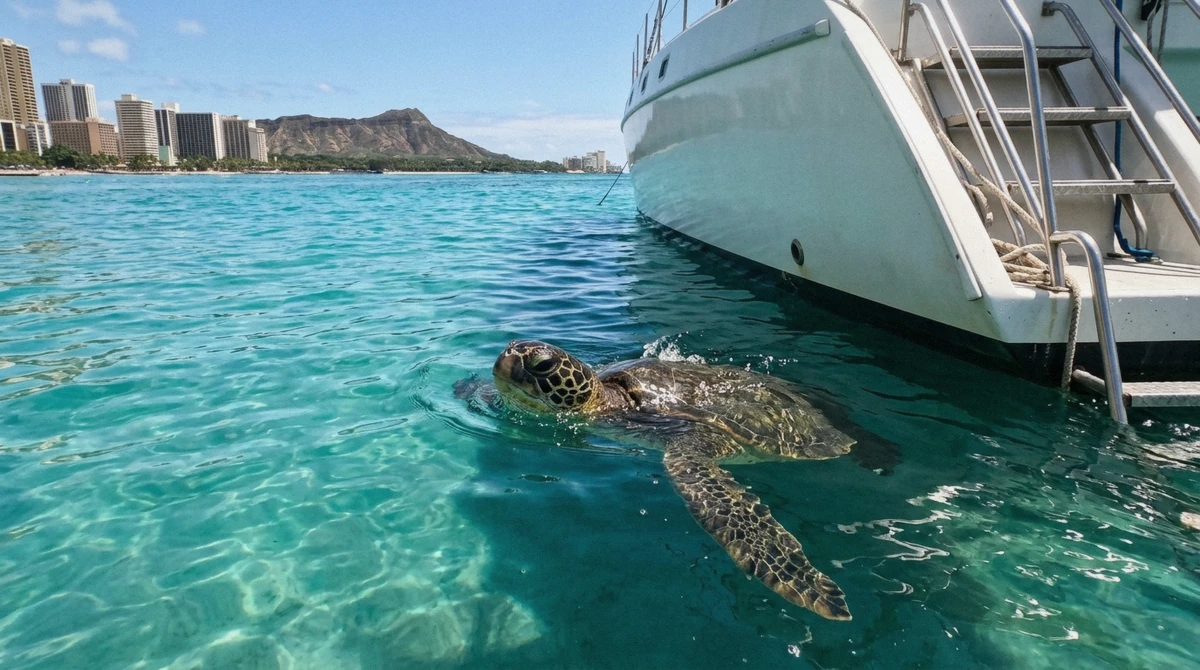
Both boats that run Turtle Canyon start from Kewalo Basin, on Oahu's south shore. The ride out takes roughly 15 minutes, tracing the shoreline past Waikiki Beach with Diamond Head coming into view off the bow. Crews use the transit time for the safety briefing and, on the operator that offers it, for pointing out spinner dolphins or migrating whales if either happens to be in the water that day.
It's a working transit, not padding: by the time the boat moors, everyone aboard has had the water-entry and turtle-etiquette rules explained once, at a normal pace, rather than rushed right before people go in.
Time at the reef
Once moored, the boat gives a second, water-specific briefing before anyone enters. Entry is by stairway on both vessels, not a jump off the side, which keeps the process calm for nervous swimmers and easy for kids. Reported time actually in the water runs close on both boats, around 45 minutes, guided by crew who swim with the group and point out turtles, rays or octopus as they're spotted rather than leaving snorkelers to search the reef alone.
One operator moors for close to an hour total once briefing and re-boarding are counted; the other keeps the whole stop closer to 45 minutes end to end. Either way, the water window is the real product being sold, and it's consistent enough between the two boats that the choice between them comes down to what happens before and after it, not the snorkel itself.
Back aboard
Climbing back up the stairway ends the water portion of the day, and what follows differs more between the two boats than the snorkel does. One offers a freshwater shower and the option to change into dry clothes before the sail back. Food and drink service, where it's included, happens on this leg: snacks and non-alcoholic drinks on the boat that keeps things simple, or a full lunch with local beer, cocktails and wine on the boat that builds its whole pitch around the meal.
The sail home retraces the outbound route, Waikiki and the Ko'olau mountains in view, and is the part of the trip both operators describe as the wind-down, the section where nobody's checking a watch.
Species at the Reef, Told Through the Reviews
Turtles and the reef fish that work on them
The core sighting is exactly what the name promises. Kendall_C, snorkeling in July 2026, put several species in one sentence: "Great snorkeling and great crew! We saw a shark, octopus and like 7 sea turtles!
The music and drinks were fire too!!" Seven turtles in a single outing sits comfortably inside the seven-to-ten range this guide already covers as a good day, and it's typical of how reviewers describe the reef: not one turtle glimpsed at a distance, but several, close enough to watch the cleaning process happen in real time.
Reef sharks, rays and other reef residents
Reef sharks turn up often enough that reviewers mention them without much drama. Susan_N, writing in July 2026, described a typical mixed sighting: "We saw lots of colorful fish and even a reef shark, not to mention all the turtles." Rays and less common reef life round out the picture. Carolyn_A, in November 2025, listed a fuller inventory from a single snorkel: "We saw turtles, a stingray, a sea cucumber, an urchin and lots of beautiful fish!" None of these are guaranteed the way the turtles are, but between the two boats' review histories they show up often enough to count as a realistic bonus rather than a rare stroke of luck.
Spinner dolphins and the manta ray sighting
Dolphins are the most commonly reported bonus sighting, usually spotted from the boat rather than in the water during the transit out or back. lillianrose01, in July 2026, wrote: "We definitely saw turtles and dolphins, which made the experience even more special." Rarer still is what Matthew_G reported in June 2026: "On our way out to Turtle Canyon, we came across a manta ray." Manta rays aren't a species either operator lists as a regular part of the site, which is exactly why the sighting stood out enough for a reviewer to mention it by name.
The whale shark cameo and seasonal humpbacks
The single most unusual sighting on record at Turtle Canyon came in June 2026, when a passing whale shark pulled a boat off its usual route. Mark_R described it: "The crew got word that a super rare whale shark was in the area. They didn't hesitate and quickly got us over there to see it." That's a one-off, not something to plan a trip around.
Humpback whales are the more dependable seasonal bonus: Jason_C, sailing in April 2026 near the tail end of the season, wrote, "We even saw some humpback whales in Waikiki Bay which was amazing, even from afar," watched from the deck on the transit out, well before the group ever reached the reef itself.
Reef Etiquette and Photography at the Reef
Keeping the reef itself intact
The no-touch rule extends past the turtles to the reef structure underneath them. Standing on coral, grabbing it for balance, or kicking too close to the bottom damages the same reef fish colonies that make the cleaning station work in the first place, so guides on both boats also brief snorkelers on staying horizontal in the water and keeping fins clear of the coral below. It's the same logic as the reef-safe, no-spray sunscreen rule covered above: individually small actions, multiplied across two boats' worth of snorkelers every day, either protect the site or slowly wear it down.
GoPro help from the crew
Neither boat requires guests to bring their own camera gear, and crews have covered for forgotten equipment before. Michelle_G, in July 2026, described exactly that: "Very easy trip to reef, good instructions on where to meet. Friendly captain and girl crew were lovely.
One sent me video as I had forgotten to bring my GoPro which was so appreciated. Saw lots of turtles!!" It's not a formal photography package on either listing, more a courtesy some crews extend when a guest turns up without a camera, but it's worth knowing before assuming you have to buy or rent gear specifically for the reef.
What actually makes reef photos work
Water clarity, not camera quality, is the real variable at Turtle Canyon. A crowded July sailing with several boats moored at once churns up sediment and reduces visibility for everyone in the water, which is why the earlier, quieter departures this guide already recommends also happen to be the better photography slots. A rash guard rather than sunscreen-covered bare arms keeps both hands free for a camera without breaking the reef-safe, no-spray rule, and staying a stable distance from a turtle rather than swimming in close for a better angle tends to produce calmer, more natural shots anyway, since a turtle that isn't being crowded keeps grooming normally instead of moving off.
Turtle Canyon by Season
Water temperature and general conditions
Honolulu's water runs about 24°C (75°F) in January and warms to roughly 27°C (80°F) by August, a narrow enough range that wetsuits aren't part of either listing's gear list in any season. The south shore is the sheltered side of Oahu, and trade winds typically build through the afternoon, which is the practical reason morning sailings tend to run calmer than afternoon ones regardless of month.
| Season | Water Temp | What to Expect at the Reef |
|---|---|---|
| December through April | Cooler end of the range, near 24°C / 75°F | Whale season overlaps the ride out; winter swells can make the crossing rougher, per reviewer accounts |
| May and June | Warming through the mid-range | Whale season tapering off; reef traffic still moderate |
| July and August | Warmest, near 27°C / 80°F | Peak crowding reported at the reef; multiple boats mooring at once thins visibility |
| September through November | Cooling back down | Shoulder season; lighter reef traffic than summer |
Matching the season to the trip
None of this changes whether you'll see turtles, since the cleaning station runs year-round regardless of season. What shifts is the ride and the crowd. Anyone traveling December through April gets a real chance at whales on the way out, as Jason_C's April 2026 sighting shows, but should also expect the rougher water conditions that show up in winter reviews across the boats that work this coast.
Anyone traveling in July or August should default to the earliest available departure, since that's the one lever available to dodge the crowded, lower-visibility water that peak-season reviewers describe.
Getting to Kewalo Basin and Parking
One harbor, two slips
Both boats that run Turtle Canyon depart from Kewalo Basin Harbor on Ala Moana Boulevard, but from different slips on the same stretch of docks. Parking at Kewalo Basin is paid for every boat that departs from it, and the general advice from both listings is the same: arrive with time to spare, since finding a spot and walking to the correct slip takes longer than it looks on a map.
The cheaper parking option
One of the two operators sits close enough to a dedicated lot that its own listing quotes an exact rate: $2 an hour, about 20 yards from the boat. That's the easiest parking logistics of the two Turtle Canyon boats, and it's worth checking which slip your booked tour uses before you drive over, since the walk and the rate both vary by operator even within the same harbor.
The Two Guarantees, Compared
Refund or re-ride: a real difference
Both Turtle Canyon boats put a written promise behind the sighting, but the mechanics aren't identical, and the difference matters more than it looks like on a marketing page.
| $59.99 Catamaran | $84.15 Lunch Cruise | |
|---|---|---|
| Promise | Guaranteed sighting or full refund | Guaranteed sighting or free second cruise |
| What you get if no turtle shows | Money back | Another sailing, same operator, no charge |
| Best for | Travelers who won't be back on Oahu soon | Travelers with days left on the island |
| How often it's invoked | Rarely, per reviewer accounts | Rarely, per reviewer accounts |
Why the distinction is worth thirty seconds of thought
A free second cruise is worth exactly as much as the traveler's remaining schedule allows. On the second-to-last day of a trip, it's a real, usable offer. On the actual last day, it's effectively nothing, since there's no way to redeem it before flying home.
A cash refund carries no such expiry: it works the same whether you booked a week-long trip or a weekend layover. Neither guarantee is likely to get invoked, since the cleaning station produces sightings on nearly every sailing, but the practical difference is real enough to factor into which boat to book if the trip's timing is tight.
Booking Timing: Morning vs Midday vs Afternoon
Why the departure time matters more than the operator
Between the two boats that run Turtle Canyon, reviewers point to departure time as the single biggest lever over how the day actually feels, more than which operator's name is on the hull. Morning sailings consistently draw the calmer-water, higher-turtle-count reviews: Meaghan_W's 9:15 departure produced an unusually high sighting count, and she wondered in her own review whether the early slot was the reason. South-shore trade winds build through the day, so a boat that leaves the dock at 8 or 9 in the morning is working with flatter water than one that leaves after lunch.
The midday trade-off
One of the two operators runs a midday departure specifically because that's when its included lunch and bar service makes sense: snorkel first while the water is still reasonable, then eat and drink on the slower sail back as the afternoon builds. The same operator's morning option skips the meal for unlimited soft drinks only, at the same fare, which means the choice between its morning and midday runs is really a choice about what kind of day you want, not a price decision.
Afternoon and the July squeeze
Later sailings, especially in July, are where the crowded, lower-visibility reviews concentrate. Multiple boats moored at the reef at once, as Haley_S described, thins out both the calm and the clarity that make the cleaning station worth visiting in the first place. If a trip's schedule allows any flexibility at all, an early booking on any month, and specifically a morning booking in July or August, is the one variable a traveler actually controls at a wildlife site that otherwise runs on its own schedule.
What Snorkelers Bring and Wear
The short list both operators repeat
Reef-safe sunscreen applied before boarding, sunglasses or a hat, and a reusable water bottle cover the essentials both listings recommend. Because sprays aren't permitted once aboard either boat, the sunscreen has to go on at the hotel or the dock, not on the water. A rash guard is a practical substitute for repeat sunscreen application on a two-hour trip and doubles as sun protection during the ride out and back, when there's no shade over most of an open catamaran deck.
What not to bring
Neither operator wants fish food, vapes or cigarettes aboard, all explicitly banned on at least one of the two listings, and glass containers are a standard no on any boat this size regardless of what the paperwork says outright. Towels are worth packing regardless of which boat you book: one supplies a freshwater shower and encourages a change of clothes, the other keeps things simpler, and either way saltwater on skin for the ride home is more comfortable with a dry towel at hand than without one.
Group Size and What It Changes at the Reef
Two different caps, one shared reef
The two boats that snorkel Turtle Canyon carry different maximum group sizes, and reviewers on both notice the difference once they're actually in the water. One operator sails at half its certified capacity, holding to a hard cap well below what the hull is rated for; the other runs closer to its full rated number on a larger vessel. Neither approach is wrong, but they produce a genuinely different couple of hours: a tighter cap means guides can learn names and adjust pace for slower swimmers, while a larger group spreads the same guided attention across more people.
What reviewers actually report
Group counts mentioned across reviews on both listings range from as few as five travelers to numbers well into the twenties, depending on the day, the season and the departure time. Barry_E (March 2026) called out a specific lucky count: "We were fortunate to hit it on a day where only 20 passengers." That variability cuts both ways, an early or off-season sailing can land a near-private group even on the boat with the higher official cap, while a popular midday summer slot can fill either boat close to its limit.
Turtle Canyon Questions
Is Turtle Canyon worth it?
For most snorkelers, yes. Both boats that run it back a turtle sighting with a written promise, either a full refund or a free second cruise, which is a stronger guarantee than most wildlife-viewing tours anywhere offer.
Can you swim to Turtle Canyon, Oahu?
No. The reef sits about 15 boat minutes offshore from Kewalo Basin, with no shore access point. A boat is the only realistic way to reach it.
Can you go to Turtle Canyon on your own?
No. There's no independent or DIY route to the site; every legitimate way to snorkel it starts with booking one of the two catamarans that run it daily.
Which is better for snorkeling, Hanauma Bay or Turtle Canyon?
Hanauma Bay suits a shore-based day without booking a boat, if its advance reservations are still available. Turtle Canyon suits anyone who wants a written turtle guarantee, gear provided, and no separate entry fee to book ahead.
How many turtles will you actually see at Turtle Canyon?
On a good day, reviewers count seven to ten individual turtles across the reef. July can get crowded with multiple boats in the water at once, which thins visibility and can make sightings feel less concentrated than a quieter month.
Are there sharks at Turtle Canyon, Oahu?
Neither tour lists reef sharks as a regular sighting at Turtle Canyon itself; the site's draw is the turtle cleaning station, with rays and octopus as the more common secondary sightings.
What does a green sea turtle cleaning station actually mean?
It means a specific patch of reef where small fish remove algae and parasites from turtle shells, and where the turtles return again and again because the arrangement benefits both species. That habitual return is why Turtle Canyon produces far more consistent sightings than a random stretch of open reef along the same coastline.
Is it legal to touch a sea turtle in Hawaii?
No. Green sea turtles are protected under Hawai'i state law and federal law, and both boats that run Turtle Canyon brief every group on watch-never-touch before anyone enters the water. Guides in the water enforce the rule directly.
What other animals will you see near Turtle Canyon besides turtles?
Reef fish working the cleaning station, and less predictably rays, octopus, sea cucumbers and reef sharks. Spinner dolphins sometimes cross the boat's path on the transit out or back, and December through April carries a real chance of humpback whales seen from the deck.
What is the water temperature at Turtle Canyon?
Around 24°C (75°F) in January and roughly 27°C (80°F) by August, a narrow enough range that neither operator lists a wetsuit as required gear in any season.
Can you bring a GoPro on a Turtle Canyon tour?
Yes, and neither boat requires one. Crew have been known to shoot video for guests who forget their own camera, per reviewer accounts, though it isn't a formal package on either listing.