 Oahu Boat Tours
Best Time of Year for Whale Watching in Oahu: Month-by-Month Guide
Last reviewed August 2026
The best time for whale watching in Oahu is December through May, when humpback whales finish a migration of about 3,500 miles from Alaska into Hawaiian waters. January through March is the peak of that window and February is the single surest month for a sighting. December and April are the honest runner-up months: whales are present but thinner, and both booking and pricing get easier at either edge of the season. June through November is the month range to skip outright, because the humpbacks are back in Alaskan feeding grounds and no Oahu boat runs a dedicated whale watch at all.
Quick answer
Whale season in Oahu runs December through May, with January through March the peak and February the surest single month, because that's when the most humpbacks have completed the swim down from Alaska and settled into Hawaiian waters to breed and calve. Outside that six-month window, no whale watch boat here sails at all.
Key takeaways
- December through May is Oahu's whale season; January through March is peak and February is the single surest month for a sighting
- December and April are the honest shoulder months: whales are present but sparser, and the 2-Hour Oahu Whale Watch at $49.95 books easier at either edge of the season
- June through November is the window to avoid outright. No Oahu whale watch boat, including this one, operates outside December to May
- Humpbacks don't feed in Hawaii at all. They make the 3,500-mile crossing on stored fat, which is the fact behind everything else on this page
- Mornings run calmer than afternoons on the south shore, before the trade winds build. Sail early if a smooth ride matters as much as the whales
- Worried about a rough winter crossing more than missing a whale? See how the six boats compare on seasickness before you book
Whale Season in Oahu at a Glance
How to read the table
The Verdict column below is the short version of everything in this guide: a three-to-five-word call on whether that month is worth booking, worth skipping, or somewhere in between. Whale presence for December through May reflects the typical shape of the migration, not a guarantee for any single sailing; June through November isn't hedged at all, because in those months there is no whale season and no boat to book.
| Month | Whale Presence | Weather | Crowds | Verdict |
|---|---|---|---|---|
| January | Building toward peak | Mild, occasional trade wind showers | High (holiday travelers still around) | Strong choice |
| February | Peak numbers | Mild, calmer trade winds | High (spring break starting) | Best overall |
| March | Peak, still strong | Mild, building trade winds | High (spring break peak) | Best overall |
| April | Numbers thinning | Warming, drier | Moderate | Good value, fewer whales |
| May | Last stragglers, season closes | Warm, dry season beginning | Moderate | Late-season gamble |
| June | None; whales in Alaska | Warm, dry, steady trade winds | High (summer travel begins) | Skip, no season |
| July | None; whales in Alaska | Warm, dry, steady trade winds | Peak (summer break) | Skip, no season |
| August | None; whales in Alaska | Warmest, dry | Peak (summer break) | Skip, no season |
| September | None; whales in Alaska | Warm, dry, transitioning | Moderate | Skip, no season |
| October | None; whales in Alaska | Warm, occasional showers return | Low to moderate | Skip, no season |
| November | None; whales in Alaska | Cooling, wet season begins | Moderate (Thanksgiving week) | Skip, no season |
| December | First arrivals | Cooler, wet season underway | High (Christmas and New Year) | Good, early-season odds |
Read that table plainly and the shape is simple: six months of a real season bracketed by six months of none at all. Within the season, February and March carry the best odds, January and December the honest edges, and April and May a fading tail worth booking only if the calendar leaves no better option.
Water temperature and rain, month by month
These are typical patterns for Honolulu's climate rather than measurements taken for this guide, so treat the numbers as a general range and check the forecast close to your dates. Ocean temperature off Waikiki runs about 24°C (75°F) in the coolest months of winter and climbs to around 27°C (80°F) at its warmest in late summer, with the shoulder months sitting in between.
| Month | Typical Water Temp | Rain |
|---|---|---|
| January | 24–25°C (75–77°F) | Moderate |
| February | 24–25°C (75–77°F) | Moderate |
| March | 24–25°C (75–77°F) | Moderate |
| April | 25–26°C (77–79°F) | Low to moderate |
| May | 25–26°C (77–79°F) | Low |
| June | 26–27°C (79–80°F) | Low |
| July | 26–27°C (79–80°F) | Low |
| August | 27°C (80°F) | Low |
| September | 27°C (80°F) | Low |
| October | 26–27°C (79–80°F) | Low to moderate |
| November | 25–26°C (77–79°F) | Moderate |
| December | 24–25°C (75–77°F) | Moderate |
Winter, which is whale season, is also the south shore's wetter and slightly cooler stretch of the year, though nothing close to a monsoon. August is the warmest month by the numbers above and January is among the coolest and wettest, which is worth knowing since it lands right inside peak whale season.
Best Season by Traveler Type
If You want the surest sighting odds
Book February or March. That's the peak of the migration, when the largest share of the season's whales are already in Hawaiian waters.
If You're budget-conscious but still want real odds
Book December or April. Whale numbers are lower than peak but still genuinely present, and both crowds and prices ease off at the season's edges.
If You want the calmest possible crossing
Sail in April or May. Trade winds are typically gentler than the peak winter months, and the season's tail end still carries a real chance of a sighting.
If You're set on a specific week regardless of season
Check the calendar first. Outside December through May there is no whale watch to book here at all, whatever the week.
If You want whales without planning an entire trip around them
Book the Turtle Canyon catamaran December through April, which runs a snorkel trip that doubles as an informal whale watch on the way out.
Why Whales Come Here: The 3,500-Mile Migration
3,500 miles, running on stored fat
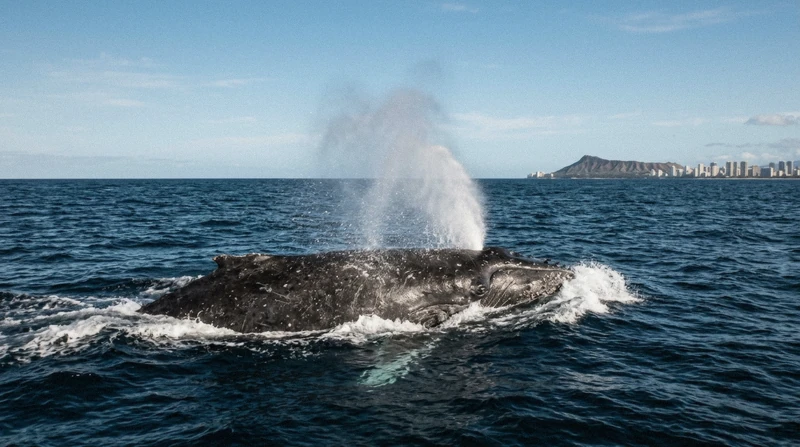
Humpback whales migrate roughly 3,500 miles (5,600 km) from Alaska to Hawaii every year, arriving as early as December and lingering as late as May. The counterintuitive part is what they do once they get here: nothing, at least not for food. Humpbacks feed almost entirely in the cold, nutrient-rich waters of Alaska during the summer, then swim the entire way to Hawaii on stored fat reserves, going largely without eating for the length of their stay.
The trip isn't about food at all. It's about warm, shallow, predator-light water that suits breeding and calving far better than the Alaskan coast.
The 100-yard rule
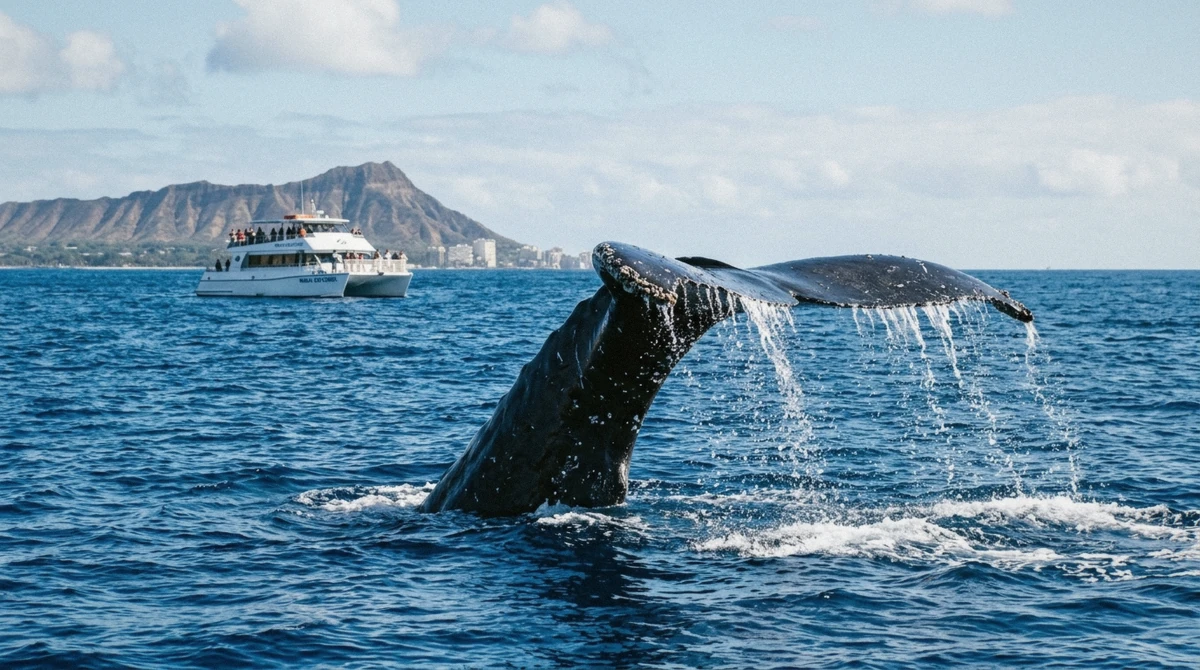
Every whale watch vessel operating in Hawaiian waters, including the one leaving Ala Wai Harbor on this page, keeps a minimum 100 yards from any humpback under federal regulation. That distance shapes what a whale watch actually looks like: a boat holding position at range while the whale surfaces, blows and occasionally breaches or tail-slaps in the open water beyond the hull, rather than a close approach. The 2-Hour Oahu Whale Watch pairs that legal distance with an underwater hydrophone, so even a whale that never breaches close to the boat can still be heard singing beneath it.
January to March: The Peak, and Morning vs Afternoon
January to March, and why February is the surest bet
January through March is the peak of the season, the stretch where the largest share of the year's humpbacks are actually present in Hawaiian waters at once. Within that window, February tends to be the single surest month, sitting past the early arrivals of January and ahead of the numbers beginning to thin by late March. None of that is a guarantee for any individual two-hour sailing.
It's a statement about which months carry the best underlying odds, which is exactly what a whale watch fare is buying: a better chance, not a promise.
Morning or afternoon, and why it matters here
Morning departures are the better call on Oahu's south shore. Trade winds are typically calmer earlier in the day and build through the afternoon, which affects the ride more than it affects whale behavior itself. A calmer morning sailing means steadier footing on deck, an easier time holding binoculars level, and a gentler introduction if seasickness is a concern on a winter crossing when swells tend to run larger than the rest of the year.
The recommendation holds even though whales themselves don't keep to a schedule: book the calmer window and let the sighting odds do the rest.
Maui vs Oahu, Honestly
Where Maui wins
Maui's Au'au Channel, the stretch of water between Maui, Lanai and Molokai, is widely considered the densest humpback breeding ground in Hawaii. Its shallow, sheltered water draws a genuinely higher concentration of whales during peak season than Oahu's more open south shore, and travelers optimizing purely for the highest possible sighting density in the shortest sailing have a real argument for booking there instead.
Where Oahu wins
Oahu's case is convenience, not density. A whale watch here leaves from Ala Wai Harbor, a short walk from most Waikiki hotels, with no inter-island flight, no rental car and no extra travel day required to reach the water. For a traveler already based in Waikiki for a broader Oahu trip, that convenience is the honest trade against Maui's denser channel: fewer logistics against a smaller but still real chance of a sighting, on the very same December-to-May calendar that governs both islands.
What If the Whales Don't Show
The return pass
A blank sailing on the 2-Hour Oahu Whale Watch earns a return pass rather than a refund. One reviewer from February 2026 reports the pass stayed valid for three years and could be used on either Oahu or Maui, which turns a disappointing two hours into a standing invitation rather than a lost fare. It's worth reading as insurance against the honest limits of a wild-animal sighting, not as a substitute for booking during the strongest months in the first place.
The informal backup: Turtle Canyon in whale season
Hawaii Nautical's Turtle Canyon catamaran doubles as an unofficial whale watch December through April, since its route out to the reef runs through the same waters the humpbacks pass on their way in. It isn't a dedicated whale watch and carries no return-pass guarantee for a blank whale sighting, but a traveler already booked on that sailing for the turtles gets a second, genuine shot at a whale on the way out and back, at no extra cost.
Booked correctly, whale season in Oahu comes down to one honest trade: February and March for the strongest odds, December and April for a calmer, cheaper version of the same bet, and June through November left alone entirely, since there's nothing on the water to book in those months regardless of how good the rest of the trip looks. For the other five boats sailing outside whale season, the full tour catalog is the place to start.
What a Sighting Actually Looks Like: A Behavior Glossary
The words a naturalist guide uses on a whale watch aren't decoration, they describe specific, recognizable behaviors, and knowing them ahead of time turns a distant splash into something identifiable. Each one below is paired with a dated 2026 review from the 2-Hour Oahu Whale Watch that recorded exactly that behavior.
| Behavior | What it looks like | Seen in a 2026 review |
|---|---|---|
| Breach | The whale launches most or all of its body clear of the water and falls back with a crash | Epifanio_G, April 2026, counted 10 breaches on one sailing |
| Tail slap | The whale lifts its tail fluke and slaps it flat against the surface, repeatedly | Referenced in the listing's own itinerary description of whale behavior to watch for |
| Fluke | The whale's tail lifts clear of the water as it dives, the classic silhouette of a whale sounding | Common at the start of a deep dive; the naturalist narration calls it out live |
| Spy hop | The whale rises vertically, head first, to look around above the surface | Less frequent than a breach but noted in the listing's behavior vocabulary |
| Mother-calf pair | A smaller whale surfacing and diving in close sync with a larger one, often playful | Peggy_C, April 2026, saw "Mama and baby with the zoomies"; Sandy_F, March 2026, and Emily_G, April 2026, each saw a mother and calf that same winter |
The gap between the glossary and a real sailing is worth naming honestly: not every trip gets a breach, and a whale that only shows a fluke before diving is still a genuine sighting, just a quieter one. The hydrophone aboard the whale watch fills part of that gap, since a whale that never breaches near the boat can still be heard singing beneath it.
Why Hawaii and Not Somewhere Closer
Two different oceans, two different jobs
Alaska and Hawaii do opposite work for a humpback whale in the same year. Alaska's cold, nutrient-dense water is where the feeding happens, months of building fat reserves on krill and small schooling fish before the swim south begins. Hawaii's warm, clear, comparatively still water does none of that.
It's shallow enough and calm enough to be safe for calving, and free enough of the predators and cold that make a newborn calf's first weeks survivable elsewhere. The trade-off is food: humpbacks eat essentially nothing in Hawaiian waters, running the entire visit, migration included, on what they stored up north.
Why the 3,500 miles is the whole strategy
That distance is not incidental, it is the mechanism that makes the arrangement work. A closer, colder breeding ground would save the whales the swim but expose newborn calves to conditions they can't yet handle. A warmer, closer feeding ground doesn't exist at the scale Alaska offers.
The 3,500-mile gap between the two is the price of getting both a rich enough feeding ground and a safe enough breeding ground within a single migratory loop, repeated every year of a humpback's life.
How Sightings Change Across the Day
Whale behavior itself doesn't run on a clock, humpbacks surface, dive and breach at all hours, but the conditions a boat sails in absolutely do, and those conditions change what a passenger is able to see and how comfortably they see it.
Morning: the calm window
Trade winds are typically weakest in the first hours after sunrise on Oahu's south shore, before the day's heating gets the air moving. A calmer sea surface makes a distant blow or a fin easier to pick out against the water, and it means less spray and less boat motion for anyone trying to hold binoculars steady. It's also, not coincidentally, the gentler ride for anyone prone to seasickness on a winter crossing.
Afternoon: more wind, same whales
By afternoon, trade winds have usually built, chopping the surface and adding whitecaps that can mask a distant breach or make a tail slap harder to distinguish from wind spray. The whales themselves aren't doing anything differently, the sightings are still there, they're simply harder to spot and confirm at range in rougher water. None of this changes the recommendation from in the month-by-month table above: book the calmer morning window if the choice is available, for the ride as much as for the odds.
Planning Around the Peak
If You're booking a February or March sailing
Book at least two weeks ahead. Peak-season demand on the 2-Hour Oahu Whale Watch runs alongside spring break travel, and the listing itself shows sailings booked an average of 17 days out, earlier than that in the strongest weeks of the peak.
If Your sailing comes back with no whales
Expect a return pass rather than a refund. Reviewers report passes honored on later sailings, in one case for up to three years, usable on Oahu or Maui. It's the operator's standard answer to a blank trip, not a rare exception.
If You're deciding between the whale watch and the turtle catamaran during whale season
December through April, Hawaii Nautical's Turtle Canyon catamaran runs a route through the same waters the humpbacks pass on the way in, so a turtle-focused trip still carries a real, if secondary, chance of a whale sighting on the way out and back.
If You want to build slack into a tight itinerary
Sail earlier in your trip rather than on the last available day. A canceled or heavily substituted sailing due to weather can usually be rebooked within a multi-day stay, but not if the whale watch was scheduled for the flight-home morning.
Whale Watching Season Questions
What month are whales most active in Oahu?
February, followed closely by March. Both sit inside the January-to-March peak of the December-to-May season, when the largest share of the year's humpbacks are present in Hawaiian waters at once.
Is morning or afternoon better for whale watching in Hawaii?
Morning. Trade winds are typically calmer earlier in the day on Oahu's south shore, which makes for a steadier ride and doesn't reduce the odds of a sighting, since whales themselves aren't on a daily schedule.
Is Maui or Oahu better for whale watching?
Maui's Au'au Channel holds a genuinely denser concentration of whales at peak season. Oahu's advantage is convenience: a whale watch here leaves a short walk from Waikiki, with no inter-island travel required to reach the water.
Is whale watching worth it in Oahu?
Yes, booked in the right months. February and March carry the strongest odds of the season; outside December through May there's no whale watch running here at all, whatever else the trip looks like.
What happens if no whales show up on an Oahu whale watch?
On the 2-Hour Oahu Whale Watch, a blank sailing earns a return pass rather than a refund. One reviewer reports a pass valid for three years, usable on a later Oahu or Maui sailing.
When does whale watching season end in Oahu?
May is typically the last month with a real chance of a sighting, as the humpbacks finish heading back toward Alaska. By June, the season is over and no dedicated whale watch boat operates until December.
What is a breach and how often do whales do it?
A breach is when a whale launches most or all of its body clear of the water and falls back with a crash, the most dramatic and most photographed behavior on a whale watch. It isn't guaranteed on every sailing, but it isn't rare either: an April 2026 review of the whale watch counted 10 breaches on a single two-hour trip.
Do humpback whales eat while they're in Hawaii?
No. Humpbacks feed almost entirely in Alaska's cold waters during the summer, then swim the 3,500-mile migration to Hawaii on stored fat, going largely without eating for the length of their stay. The trip is about safe, warm water for breeding and calving, not food.
How far in advance should I book a whale watch during peak season?
At least two weeks. The 2-Hour Oahu Whale Watch is booked an average of 17 days ahead, and February and March sailings compete with spring break travel for space, so the strongest weeks of the peak fill earliest.
What is a spy hop, and will I see one?
A spy hop is when a whale rises vertically out of the water, head first, apparently to look around above the surface. It's less common than a breach or a tail slap on any given sailing, but it's part of the same behavior vocabulary a naturalist guide narrates for throughout the 2-Hour Oahu Whale Watch, whether or not one happens to occur on a specific trip.